





Apple Vision Pro in 2026: what you need to know two years after launch
Apple Vision Pro is one of the most advanced mixed-reality headsets on the market. Two years after its US launch, however, it remains a premium niche device rather than a mass-market headset for a broad audience.
Since February 2024, Apple has expanded Vision Pro sales to new countries, including China, Japan, Singapore, Australia, Canada, France, Germany, the United Kingdom, South Korea, the UAE, and Taiwan. It has also improved visionOS, added Apple Intelligence, strengthened Mac integration, and released an updated model with the Apple M5 chip and the Dual Knit Band.
At the same time, the high price, weight, limited battery life, slow growth in the number of apps, and unclear everyday use case remain the main barriers to broader adoption.
What is Apple Vision Pro
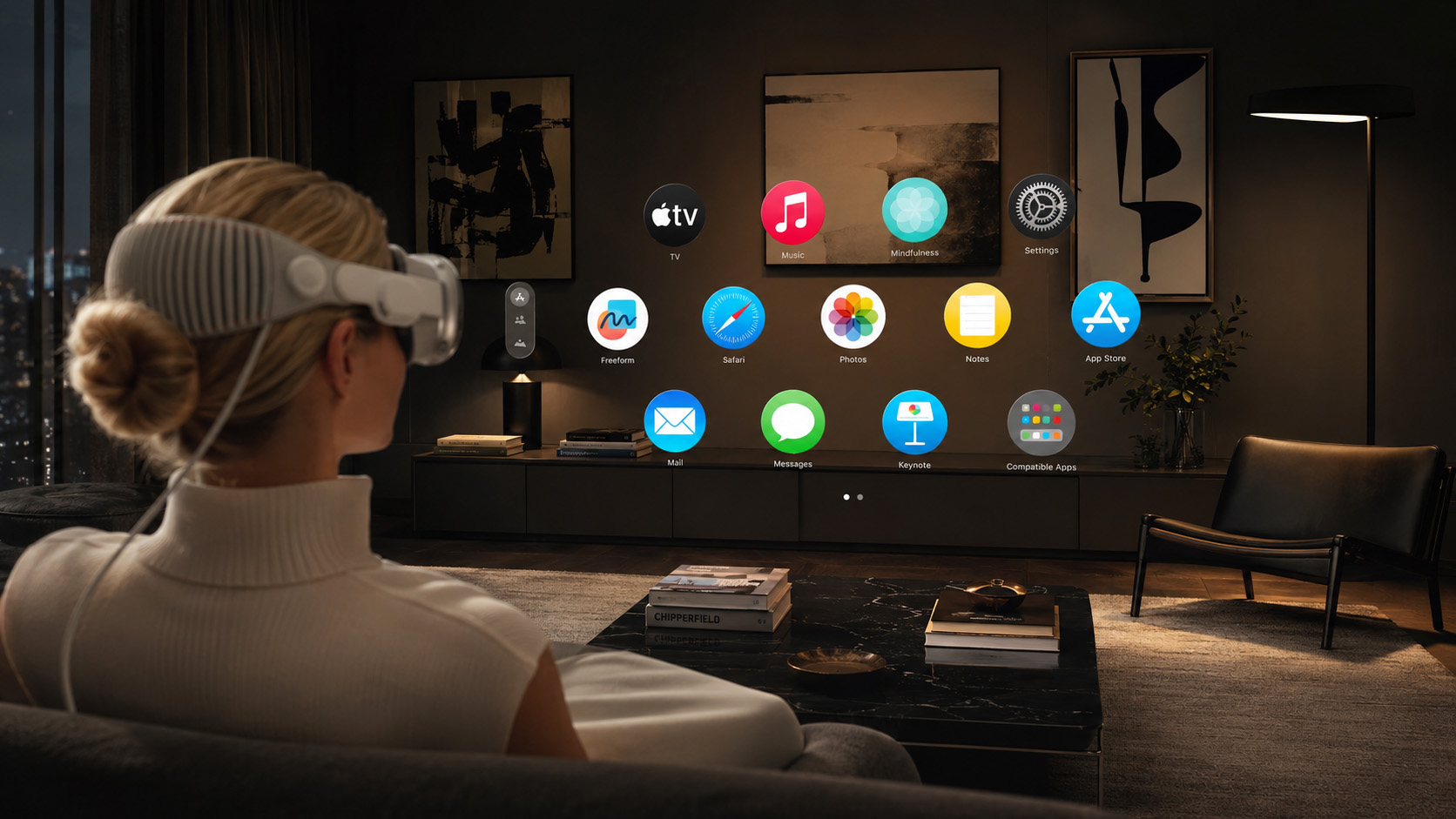
Apple Vision Pro is Apple’s MR headset. Simply put, it is a headset that lets users interact with app windows, video, and other digital content directly in the space around them.
It is often called Apple’s VR headset or Apple’s virtual reality headset, but it is not exactly a regular VR headset. Vision Pro is an MR headset: it does not only immerse users in virtual reality. It also shows the real world through cameras, lets users control the interface with their eyes and hands, works with a Mac through Mac Virtual Display, and turns the user’s surroundings into a large virtual workspace.
The main strengths of Vision Pro are its displays, passthrough mode, eye and hand tracking, and integration with the Apple ecosystem.
The difference between VR, AR, and MR headsets
VR — Virtual Reality
Fully immerses users in an artificial world.
The real world is completely blocked out by a display.
Users see a fully computer-generated environment.
Examples: Meta Quest 2/3, PlayStation VR, Valve Index.
Best suited for games, simulators, and full immersion.
AR — Augmented Reality
The real world remains the foundation, with digital objects overlaid on top of it.
It usually uses a transparent display, as in glasses, or a smartphone/tablet.
Digital objects do not interact with the real world; they are simply overlaid on the real-world view.
Examples: Google Glass, some smartphone apps such as Pokémon GO, and HoloLens in basic AR scenarios.
MR — Mixed Reality
This is a more advanced hybrid of AR and VR.
The real and virtual worlds interact with each other in real time.
Virtual objects can appear on a real table, hide behind real-world objects, and react to them.
Passthrough mode is often used: cameras show the real world in high quality, with graphics overlaid on top.
In brief:
VR: fully virtual environment
AR: real world plus digital overlay
MR: real and virtual worlds interact
Which category does Apple Vision Pro belong to?
Apple Vision Pro is a mixed-reality (MR) headset or a spatial computing device, in Apple’s terminology.
Technically, it is built on the basis of a VR headset: it is opaque and uses passthrough mode, where cameras capture the world and display it on micro-OLED screens.
As a user experience, however, it is mixed reality: digital content fits into real space, objects interact with the environment, and users can work with app windows around them.
Apple itself avoids the terms VR, AR, and MR and calls this spatial computing, but Vision Pro is generally described as a mixed-reality headset.
Apple Vision Pro in 2026: what has changed after two years
The main Apple Vision Pro news over the past two years did not involve a full second-generation model, but gradual improvements.
The most noticeable update came on October 15, 2025. Apple introduced Vision Pro with the Apple M5 chip and the new Dual Knit Band. The device became more powerful, received a more comfortable fit, sharper rendering, up to 10% more rendered pixels on the micro-OLED displays, and a refresh rate of up to 120 Hz in passthrough view.
Battery life also improved slightly: up to 2.5 hours of general use and up to 3 hours of video playback.
Importantly, this is not Apple Vision Pro 2. It is an updated version of the first Vision Pro.
Apple Vision Pro proved to be technologically impressive, but it did not become a mass-market product. The high price, weight, limited battery life, and unclear everyday use case prevent it from becoming a mainstream device.
How visionOS and Apple Intelligence developed
Over the past two years, some of the most important changes to Vision Pro have come not only from hardware, but also from software. Apple gradually improved visionOS and made the headset more practical for work, media, and Mac integration. It also added Apple Intelligence, its own AI feature set.
visionOS 1.1 added features for enterprise use: mobile device management (MDM), Managed Apple IDs, volume deployment, remote erase, as well as improvements to the user’s digital image, Persona, and the display of the user’s eyes on Vision Pro’s external screen, EyeSight.
visionOS 2 made the headset more convenient for everyday use. It introduced spatial photos from regular 2D images, along with new gestures, Bluetooth mouse support, improved Guest User mode, and Travel Mode.
visionOS 2.2 improved one of the key areas for Vision Pro: working with a Mac. Wide and Ultrawide modes in Mac Virtual Display made the headset more practical as a large virtual workspace.
visionOS 2.4 added Apple Intelligence. New features became available on Vision Pro: text tools, Writing Tools, an image generator, Image Playground, the ability to create personal emojis with Genmoji, Smart Reply, Priority Notifications, and Spatial Gallery.
As a result, Apple Intelligence became a key part of Vision Pro. The headset stopped being just an expensive screen on the face and became part of Apple’s broader Apple Intelligence strategy.
Key Apple Updates from WWDC 2026
Apple held its annual WWDC 2026 conference, with the main focus on Apple Intelligence, the revamped Siri AI, and optimizations across all operating systems: iOS 27, iPadOS 27, macOS 27 Golden Gate, watchOS 27, tvOS 27, and visionOS 27. This was Tim Cook’s final presentation as CEO — starting in September, John Ternus will take over the role.
Main Highlights
Apple Intelligence powered by Google Gemini. The AI has been completely rebuilt in partnership with Google. It better understands context, remembers user information, analyzes the screen, and works with multiple files simultaneously. Most processing happens on-device for maximum privacy.
Siri AI — Next-Level Assistant. Siri now has its own dedicated app with conversation history, a more natural and customizable voice, on-screen context awareness, and integration into Dynamic Island and Spotlight. The assistant can search the web, edit text, analyze photos and files, and maintain full conversations. On Vision Pro, Siri AI appears as an interactive glowing orb.
Performance & Liquid Glass Design. Apps launch up to 30% faster, AirDrop works 80% faster, and photo and file loading has been improved. A new transparency slider for the Liquid Glass interface was introduced, icons have become more volumetric, and search is now smarter and more contextual.
Parental Controls & Safety. Apple significantly enhanced child account management: app and website approvals, communication limits, flexible screen time controls, and usage statistics. Tools are also available for elderly family members.
New AI Features in Apps
Photos: voice and gesture editing, Spatial reframe for changing perspective with AI inpainting, and automatic organization.
Safari: tab grouping by topics and notifications about changes on websites.
Shortcuts: creating automations using simple text or voice.
Passwords: bulk changing of compromised passwords.
Availability
Siri AI and advanced Apple Intelligence features launch in English first, with other languages to follow later.
Full functionality requires iPhone 15 Pro and newer, iPad with M1 or newer, Mac with M1 or newer, Apple Watch Series 10 or Ultra 2 and newer, and Apple Vision Pro.
Public betas arrive in July 2026, with the full release planned for fall.
These updates are particularly relevant for Apple Vision Pro and visionOS 27: Siri AI and Apple Intelligence will become a more natural and contextual part of the immersive experience.
Apple Vision Pro apps and demos
From launch, Apple emphasized in-store Vision Pro demos. The headset is easier to understand once someone tries it in person and sees how windows, gestures, video, and passthrough mode work.
The situation with apps was mixed. At launch, Apple talked about more than 600 native apps for Vision Pro and more than 1 million compatible iOS and iPadOS apps. Later, the number of native Vision Pro apps grew to more than 2,500, alongside more than 1.5 million compatible apps.
However, many of those apps were merely compatible rather than built specifically for Vision Pro.
At launch, there was no integration of Netflix, YouTube, and Spotify apps. YouTube for Vision Pro launched only on February 12, 2026. This was a notable update, but it also showed that even major services were slow to support Vision Pro.
Meta Quest 3 and Apple Vision Pro: what is the difference
Meta Quest 3 and Apple Vision Pro can be compared, but the two devices target different audiences.
Vision Pro is an expensive high-end product. It focuses on display quality, passthrough mode, eye and hand tracking, Apple integration, and spatial computing.
Meta chose a different path. It is developing a more affordable mixed-reality ecosystem. Quest 3S was released at a price of $299.99, which is much lower than the Vision Pro starting price of $3,499.
The key problems of Vision Pro
Vision Pro has strong points, but its limitations are also clear.
The main problems of the headset are the high price, weight, limited battery life, unclear everyday use case for mainstream users, slow growth of app integration, and reports of weak demand.
That does not make the device bad. On the contrary, Vision Pro remains technically impressive.
Another issue is user reports about microcracks on the front glass above the bridge of the nose. Apple has not publicly acknowledged this problem. It is unclear whether the company is collecting information about these cases.
When Apple Vision Pro 2 will be released
There is no official release date for Apple Vision Pro 2.
Apple released an updated Vision Pro with the Apple M5 chip, but the company has not announced a separate product called Apple Vision Pro 2.
Rumors about a lighter model, a cheaper version, a headset connected to a Mac, or future AR glasses remain rumors. They cannot be considered confirmed Apple plans.
For now, the only clear point is that Apple continues to develop the Vision Pro platform, but the next big step has not been officially confirmed.
Brief timeline of Apple Vision Pro
Vision Pro launched in the US at a starting price of $3,499.
visionOS 1.1 added enterprise features and improvements to Persona and EyeSight.
Vision Pro entered international markets, including China, Japan, France, Germany, and the United Kingdom.
visionOS 2 was released with spatial photos, new gestures, and Guest User improvements.
visionOS 2.2 added Wide and Ultrawide Mac Virtual Display.
visionOS 2.4 added Apple Intelligence beta and Spatial Gallery.
Apple showed visionOS 26.
Vision Pro with the Apple M5 chip and the Dual Knit Band was released.
a native YouTube app for visionOS launched.
FAQ
What is Apple Vision Pro?
Apple Vision Pro is Apple’s MR headset. It combines passthrough mode, eye and hand tracking, visionOS apps, immersive content, and Mac integration.
Is Apple Vision Pro a VR headset?
Partly. Vision Pro can run immersive VR experiences, but it also uses high-quality passthrough and spatial interfaces, which makes it closer to a mixed-reality headset.
How much does Apple Vision Pro cost?
In the US, the starting price was $3,499. After the update with the Apple M5 chip, it remained the same. In the United Kingdom, the price became from £3,199, and in the eurozone — from €3,699.
Has Apple already released Vision Pro 2?
No. Apple released an updated Vision Pro, but a separate Apple Vision Pro 2 has not been officially announced.
What changed with Apple Intelligence on Vision Pro?
Apple Intelligence was added to Vision Pro through visionOS 2.4. The features included Writing Tools, Image Playground, Genmoji, Smart Reply, Priority Notifications, and Spatial Gallery.
Conclusion
Apple Vision Pro in 2026 is not a failure, but it is also not a mass-market product. It is a powerful, expensive, and in many ways experimental headset through which Apple is developing mixed-reality technology, visionOS, and Apple Intelligence.
In the two years since launch, Vision Pro has become better: new features were added, Apple Intelligence became available, Mac integration improved, the number of apps grew, and a version with the Apple M5 chip was released. However, the main barriers remain: price, weight, battery life, and an unclear everyday use case.
Vision Pro is best suited for people already invested in the Apple ecosystem, Mac users who want a large virtual workspace, visionOS developers, and early adopters interested in spatial computing.
For mainstream users, it is still too expensive and too niche. As a platform for the future development of mixed reality, however, Apple Vision Pro remains important to Apple’s spatial-computing strategy.


