Calculate the financial model
Рассчитать финансовую модель
Рассчитать финансовую модель
ORDER AN ANVIO GAME ZONE
Остались вопросы?
STILL HAVE QUESTIONS?






This website uses cookies to ensure you get the best experience
Popular VR Games for Virtual Reality Arenas in 2025−2026
Reading time: 7 minutes
Updated: 24.04.2026

We have gathered experience from our VR arenas and partners to prepare a current overview of VR games that perform well in virtual reality arenas. This article highlights which games are best suited for different types of visits, what should be included in the game menu, and which titles deserve attention in 2025−2026.
Table of Contents
Quick Game Comparison

Game | Genre | Players | Average Session Time | Difficulty for Beginners | Best For | Limitations |
Beat Saber | Rhythm arcade | 1-2 | 10-15 min | Low | First visits, parties | Single player only |
Job Simulator | Casual simulator | 1 | 10-15 min | Very low | Children, families, beginners | Single player only |
SUPER HOT VR | Shooter puzzle | 1 | 10-20 min | Low | Short bright sessions | Single player only |
Cook-Out | Co-op | 2-4 | 15-20 min | Low | Families, birthdays | Maximum 4 players |
Walkabout Mini Golf VR | Sports | 1-8 | 20-30 min | Low | Groups, corporate events | Less adrenaline |
Among Us 3D | Social game | 4-10 | 20-30 min | Medium | Groups, teenagers | Minimum 4 players |
Pavlov VR | Tactical shooter | 2-10 | 20-30 min | High | Adults, tournaments | Not suitable for beginners |
Revolta | Arena PvP shooter | 1-12 | 25-30 min | Medium | Tournament, groups | Best for groups |
Top Games for VR Arenas
City Z
City Z is a zombie shooter designed for virtual reality arenas. Players must escape a ruined city, navigate a dangerous route, and fight off hordes of the undead.
How the session works: Players receive weapons and move along the route, pass through dark and dangerous areas, defend against waves of zombies, and work together to reach the goal and survive.
Who it suits: Teenagers and adults, groups of friends, fans of intense action games, venues needing a spectacular group format.
Players: 1−4
Average play time: 30 minutes
Advantages: Clear objective and straightforward scenario, high level of tension and engagement, excellent for co-op play, strong visual impact for a VR arena.
Limitations: Can be too intense for complete beginners, better suited for those who enjoy shooters and dark atmospheres.
How the session works: Players receive weapons and move along the route, pass through dark and dangerous areas, defend against waves of zombies, and work together to reach the goal and survive.
Who it suits: Teenagers and adults, groups of friends, fans of intense action games, venues needing a spectacular group format.
Players: 1−4
Average play time: 30 minutes
Advantages: Clear objective and straightforward scenario, high level of tension and engagement, excellent for co-op play, strong visual impact for a VR arena.
Limitations: Can be too intense for complete beginners, better suited for those who enjoy shooters and dark atmospheres.

Photo: © Anvio
Beat Saber
Beat Saber is one of the most accessible and visually striking games for VR arenas. Players slice flying blocks in time with music, quickly grasp the mechanics, and receive an immediate emotional response. It works well as a starting format for a wide range of guests.
How the session works: The player selects a track and difficulty level, slices blocks in the correct direction, and dodges obstacles. The format performs best in short sessions.
Who it suits: Beginners, teenagers, first-time visitors, parties.
Players: 1 player in the basic arena scenario
Average play time: 10−15 minutes
Advantages: Fast to learn, high visual appeal, wide variety of content, clear mechanics even without prior experience.
Limitations: Single-player only, players tire during longer sessions.
How the session works: The player selects a track and difficulty level, slices blocks in the correct direction, and dodges obstacles. The format performs best in short sessions.
Who it suits: Beginners, teenagers, first-time visitors, parties.
Players: 1 player in the basic arena scenario
Average play time: 10−15 minutes
Advantages: Fast to learn, high visual appeal, wide variety of content, clear mechanics even without prior experience.
Limitations: Single-player only, players tire during longer sessions.

Photo: © Beat Games
Job Simulator
Job Simulator offers a gentle and safe first VR experience for those new to the technology. The game is a humorous simulator of various professions where players interact with objects, complete simple tasks, and learn basic VR logic without stress or overload.
How the session works: The player enters one of the work areas, picks up objects, moves them, and completes simple tasks. Experimentation with the environment is encouraged, and learning is built seamlessly into gameplay.
Who it suits: Children, family audiences, beginners, those afraid of complex controls.
Players: 1
Average play time: 10−15 minutes
Advantages: Does not cause motion sickness, easy to explain in under a minute, ideal for first-time VR introduction.
Limitations: Single-player only, limited narrative, becomes repetitive on repeated plays.
How the session works: The player enters one of the work areas, picks up objects, moves them, and completes simple tasks. Experimentation with the environment is encouraged, and learning is built seamlessly into gameplay.
Who it suits: Children, family audiences, beginners, those afraid of complex controls.
Players: 1
Average play time: 10−15 minutes
Advantages: Does not cause motion sickness, easy to explain in under a minute, ideal for first-time VR introduction.
Limitations: Single-player only, limited narrative, becomes repetitive on repeated plays.

Photo: © Owlchemy Labs
SUPERHOT VR
SUPER HOT VR is a vibrant single-player action game where time moves only when the player moves. This mechanic creates a striking visual effect, gives a strong sense of control, and works well for short but memorable arena sessions.
How the session works: The player completes short combat scenes, dodges bullets and attacks, uses weapons and improvised objects. Each scene is built around movement and timing.
Who it suits: Adults and beginners, guests seeking a "wow" effect, short demonstration sessions.
Players: 1
Average play time: 10−20 minutes
Advantages: Strong visual impact, clear mechanics, no motion sickness.
Limitations: Single-player only.
How the session works: The player completes short combat scenes, dodges bullets and attacks, uses weapons and improvised objects. Each scene is built around movement and timing.
Who it suits: Adults and beginners, guests seeking a "wow" effect, short demonstration sessions.
Players: 1
Average play time: 10−20 minutes
Advantages: Strong visual impact, clear mechanics, no motion sickness.
Limitations: Single-player only.

Photo: © SUPERHOT Team
Revolta
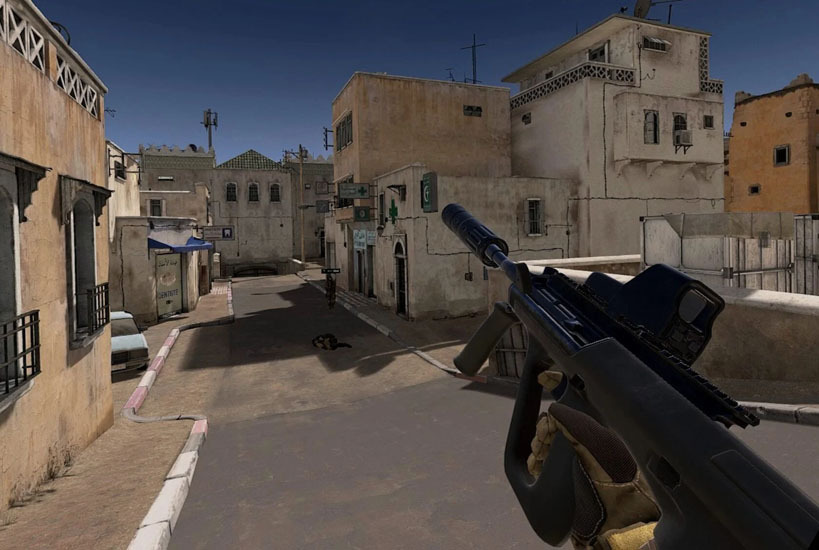
Revolta is a team shooter for virtual reality arenas where players divide into opposing sides and fight on compact maps with free movement.
How the session works: Players select a match mode, fight each other on one of the maps, use primary and special weapons, and win by points, rounds, or capturing objectives depending on the mode.
Who it suits: Teenagers and adults, groups of friends, competitive events, venues needing clear team action.
Players: Depends on arena size and game version
Average play time: 30 minutes
Advantages: Clear competitive mechanics, well-suited for tournaments and group visits, high replay value due to different modes and maps.
Limitations: Best experienced in a group rather than solo.
How the session works: Players select a match mode, fight each other on one of the maps, use primary and special weapons, and win by points, rounds, or capturing objectives depending on the mode.
Who it suits: Teenagers and adults, groups of friends, competitive events, venues needing clear team action.
Players: Depends on arena size and game version
Average play time: 30 minutes
Advantages: Clear competitive mechanics, well-suited for tournaments and group visits, high replay value due to different modes and maps.
Limitations: Best experienced in a group rather than solo.

Photo: © Anvio
Cook-Out: A Sandwich Tale
Cook-Out is one of the most convenient co-op games for families, small groups, and birthdays. It is a fun VR kitchen simulator where players take orders, coordinate actions, and quickly engage in teamwork without lengthy rule explanations.
How the session works: Players receive orders, chop ingredients, assemble dishes, pass items to each other, and keep up with the overall pace.
Who it suits: Families, children’s parties, groups of friends, guests who value team dynamics.
Players: 2−4
Average play time: 15−20 minutes
Advantages: Very clear co-op, loud and emotional format, easy to sell, beginners quickly understand the process.
Limitations: Maximum 4 players at once, mechanics can feel repetitive in long sessions.
How the session works: Players receive orders, chop ingredients, assemble dishes, pass items to each other, and keep up with the overall pace.
Who it suits: Families, children’s parties, groups of friends, guests who value team dynamics.
Players: 2−4
Average play time: 15−20 minutes
Advantages: Very clear co-op, loud and emotional format, easy to sell, beginners quickly understand the process.
Limitations: Maximum 4 players at once, mechanics can feel repetitive in long sessions.

Photo: © Resolution Games
Walkabout Mini Golf VR
Walkabout Mini Golf VR is a calm, accessible format for VR arenas when the focus is on comfortable group interaction rather than action. It holds attention well, suits a broad audience, and is particularly useful for adult groups, families, and corporate visits.
How the session works: Players move through a course with holes, take turns hitting the ball, and score based on the number of strokes. The pace is relaxed.
Who it suits: Adult groups, families, corporate events, guests who do not need intense action.
Players: 1−8
Average play time: 20−30 minutes
Advantages: Quick to learn, low motion sickness, convenient for conversation, good for repeat visits.
Limitations: Less engagement than shooters or rhythm games.
How the session works: Players move through a course with holes, take turns hitting the ball, and score based on the number of strokes. The pace is relaxed.
Who it suits: Adult groups, families, corporate events, guests who do not need intense action.
Players: 1−8
Average play time: 20−30 minutes
Advantages: Quick to learn, low motion sickness, convenient for conversation, good for repeat visits.
Limitations: Less engagement than shooters or rhythm games.

Photo: © Mighty Coconut
Among Us 3D
Among Us 3D is a VR deduction game where some players complete tasks to launch a spaceship while others act as impostors trying to sabotage the round and eliminate crewmates.
How the session works: Players receive roles, complete tasks or sabotage, and hold discussions and votes after suspicious events.
Who it suits: Groups of friends, teenagers, parties, corporate events.
Players: 4−10
Average play time: 20−30 minutes
Advantages: Excellent for groups, high engagement, strong emotional reactions, good for repeated plays.
Limitations: Requires a minimum of 4 players, needs detailed briefing.
How the session works: Players receive roles, complete tasks or sabotage, and hold discussions and votes after suspicious events.
Who it suits: Groups of friends, teenagers, parties, corporate events.
Players: 4−10
Average play time: 20−30 minutes
Advantages: Excellent for groups, high engagement, strong emotional reactions, good for repeated plays.
Limitations: Requires a minimum of 4 players, needs detailed briefing.

Photo: © Schell Games, Innersloth
Pavlov VR
Pavlov VR is a tactical VR shooter for adults and more experienced players who want a serious competitive format rather than simple entertainment. The game resembles classic team shooters but emphasizes realism in VR: manual reloading, precise aiming, and realistic weapon behavior.
How the session works: Players divide into teams, participate in short rounds on maps, use weapons with manual reloading, and play in match or tournament modes.
Who it suits: Adult audiences, experienced players, tournaments, guests who enjoy competitive modes.
Players: 2−10
Average play time: 20−30 minutes
Advantages: High engagement, deep mechanics, well-suited for tournaments, strong appeal to competitive players.
Limitations: Steep learning curve for beginners, requires extended briefing.
How the session works: Players divide into teams, participate in short rounds on maps, use weapons with manual reloading, and play in match or tournament modes.
Who it suits: Adult audiences, experienced players, tournaments, guests who enjoy competitive modes.
Players: 2−10
Average play time: 20−30 minutes
Advantages: High engagement, deep mechanics, well-suited for tournaments, strong appeal to competitive players.
Limitations: Steep learning curve for beginners, requires extended briefing.

Photo: © Vankrupt Games
Gorilla Tag
Gorilla Tag is a very popular format among children and teenagers. Players move only with their arms, jump, climb, and play active tag games. The unusual physics and high physical activity make it highly engaging.
How the session works: Players move without traditional sticks, push off surfaces with their hands, run, chase, and escape in simple competitive modes.
Who it suits: Teenagers, active children, lively groups, short energetic sessions.
Players: Depends on mode (Tag — up to 3 players, Infection — from 4 players)
Average play time: 10−15 minutes
Advantages: Quick engagement, high popularity with young audiences, energetic gameplay, works well for parties.
Limitations: Requires careful space management, can be too active for some guests, needs behavior monitoring.
How the session works: Players move without traditional sticks, push off surfaces with their hands, run, chase, and escape in simple competitive modes.
Who it suits: Teenagers, active children, lively groups, short energetic sessions.
Players: Depends on mode (Tag — up to 3 players, Infection — from 4 players)
Average play time: 10−15 minutes
Advantages: Quick engagement, high popularity with young audiences, energetic gameplay, works well for parties.
Limitations: Requires careful space management, can be too active for some guests, needs behavior monitoring.

Photo: © Another Axiom Inc.
Ragnarock
Ragnarock is a music game set in a Viking world where players drum to make the ship sail faster. Built on rhythm, loud music, and simple but spectacular action, it suits short and vibrant sessions.
How the session works: The player selects a song and difficulty, strikes drums at the right moments. More accurate hits make the ship move faster. Can be played for score or competition.
Who it suits: Teenagers and adults, music lovers, fans of fast games, parties and short entertainment sessions, venues needing visual appeal.
Players: One player; some modes allow play with others
Average play time: 10−15 minutes
Advantages: Simple and clear objective, bright action from the first minutes, works well in short format, good for repeat plays.
Limitations: Requires active arm movement, tiring in long sessions.
How the session works: The player selects a song and difficulty, strikes drums at the right moments. More accurate hits make the ship move faster. Can be played for score or competition.
Who it suits: Teenagers and adults, music lovers, fans of fast games, parties and short entertainment sessions, venues needing visual appeal.
Players: One player; some modes allow play with others
Average play time: 10−15 minutes
Advantages: Simple and clear objective, bright action from the first minutes, works well in short format, good for repeat plays.
Limitations: Requires active arm movement, tiring in long sessions.

Photo: © WanadevStudio
I Am Cat
I Am Cat is a humorous game where the player becomes a domestic cat, explores the house, causes mischief, steals items, and completes simple tasks. It is a light and accessible format that appeals to children, families, and fans of funny games.
How the session works: The player moves around the house, explores rooms, jumps, knocks over objects, hides, and completes simple tasks or simply creates playful chaos.
Who it suits: Children, family audiences, fans of light and funny games.
Players: Mainly one player; some versions offer joint modes
Average play time: 10−15 minutes
Advantages: Unusual and easily explained concept, causes laughter for both player and spectators, requires no long training, good for short visits.
Limitations: More entertainment than competition, best in short format. Check available modes for your venue before launch.
How the session works: The player moves around the house, explores rooms, jumps, knocks over objects, hides, and completes simple tasks or simply creates playful chaos.
Who it suits: Children, family audiences, fans of light and funny games.
Players: Mainly one player; some versions offer joint modes
Average play time: 10−15 minutes
Advantages: Unusual and easily explained concept, causes laughter for both player and spectators, requires no long training, good for short visits.
Limitations: More entertainment than competition, best in short format. Check available modes for your venue before launch.

Photo: © NEW FOLDER GAMES LTD, Estoty
Vox Machinae
Vox Machinae is a game about battles with giant combat robots. The player sits in the cockpit, controls movement, and fights opponents. It is a more complex and deeper format suited for those seeking a serious gaming experience rather than a first VR introduction.
How the session works: The player selects a combat machine and weapons, fights on large maps, controls movement, shooting, and positioning, and defeats opponents through accuracy and smart decisions.
Who it suits: Experienced players, fans of sci-fi and combat machines, those wanting deeper gameplay, adult groups and competitive events.
Players: Single-player and multiplayer available
Average play time: 20−30 minutes
Advantages: Strong sensation of controlling a huge machine, unusual and memorable format, good for repeat visits, combines single-player and competitive modes.
Limitations: Complex controls, not ideal for beginners, may cause motion sickness for some guests.
How the session works: The player selects a combat machine and weapons, fights on large maps, controls movement, shooting, and positioning, and defeats opponents through accuracy and smart decisions.
Who it suits: Experienced players, fans of sci-fi and combat machines, those wanting deeper gameplay, adult groups and competitive events.
Players: Single-player and multiplayer available
Average play time: 20−30 minutes
Advantages: Strong sensation of controlling a huge machine, unusual and memorable format, good for repeat visits, combines single-player and competitive modes.
Limitations: Complex controls, not ideal for beginners, may cause motion sickness for some guests.

Photo: © Space Bullet Dynamics Corporation
The Forest
The Forest is a survival game with horror elements. After a plane crash, the player builds shelter, searches for food, explores caves, and defends against dangerous creatures. It is a dark and deep format suited for adult audiences.
How the session works: The player gathers resources, crafts items, builds camp and fortifications, explores the forest and caves, fights enemies, and tries to survive as long as possible.
Who it suits: Adult players, fans of scary games, groups who enjoy co-op survival, audiences ready for a more intense and longer session.
Players: Single-player or multiplayer
Average play time: 30−60 minutes
Advantages: Deep and atmospheric experience, strong immersion, good for co-op play, high repeat visit potential among experienced players.
Limitations: Not suitable for short sessions, difficult for beginners, too heavy for children and family audiences, requires more time and attention than light arcade games.
How the session works: The player gathers resources, crafts items, builds camp and fortifications, explores the forest and caves, fights enemies, and tries to survive as long as possible.
Who it suits: Adult players, fans of scary games, groups who enjoy co-op survival, audiences ready for a more intense and longer session.
Players: Single-player or multiplayer
Average play time: 30−60 minutes
Advantages: Deep and atmospheric experience, strong immersion, good for co-op play, high repeat visit potential among experienced players.
Limitations: Not suitable for short sessions, difficult for beginners, too heavy for children and family audiences, requires more time and attention than light arcade games.

Photo: © Endnight Games Ltd
Games by Audience
- For Beginners
Job Simulator — best entry point to VR
Beat Saber — quick to explain and instantly enjoyable
SUPER HOT VR — delivers a strong "wow" effect
Walkabout Mini Golf VR — suitable for those wanting a calm group format
Beat Saber — quick to explain and instantly enjoyable
SUPER HOT VR — delivers a strong "wow" effect
Walkabout Mini Golf VR — suitable for those wanting a calm group format
- For Children
Job Simulator — simple and safe starting game
Cook-Out — fun co-op for families and parties
Gorilla Tag — strong draw for teenagers
Cook-Out — fun co-op for families and parties
Gorilla Tag — strong draw for teenagers
- For Experienced Players
Pavlov VR — for those wanting a tactical shooter
Revolta — for group PvP sessions and tournaments
Vox Machinae — for players who enjoy complex mechanics
The Forest — for fans of survival and deeper experiences
Revolta — for group PvP sessions and tournaments
Vox Machinae — for players who enjoy complex mechanics
The Forest — for fans of survival and deeper experiences
Games for Tournaments and Groups
Among Us 3D — ideal for groups focused on communication, suspicion, and team dynamics
Revolta — strong choice for competitive team matches and tournament formats
Pavlov VR — for players seeking a more serious tactical shooter
Walkabout Mini Golf VR — suitable for relaxed competitions and friendly groups
Elven Assassin — convenient format for short tournaments and team sessions
City Z — good choice for groups wanting joint action and tense atmosphere
Revolta — strong choice for competitive team matches and tournament formats
Pavlov VR — for players seeking a more serious tactical shooter
Walkabout Mini Golf VR — suitable for relaxed competitions and friendly groups
Elven Assassin — convenient format for short tournaments and team sessions
City Z — good choice for groups wanting joint action and tense atmosphere
How to Build a Game Menu for a VR Arena
- For First Visits
- Use Job Simulator as a gentle introduction
- Add Beat Saber for quick "wow" effect
- Include SUPER HOT VR for bright single-player experience
- For Birthdays
- Use Cook-Out as the co-op foundation
- Add Gorilla Tag for the active part
- Include Among Us 3D for communication and group emotion
- For Corporate Events
- Offer Walkabout Mini Golf VR for comfortable competition
- Add Among Us 3D for social dynamics
- Use Revolta for more active team play
- For Family Audiences
- Build the menu around simple and clear games
- Use Job Simulator, Cook-Out, and similar light titles
- Avoid overly complex PvP formats in the starter package
- For Players Who Prefer Challenge
- Create a separate section for advanced games
- Add Pavlov VR, Vox Machinae, The Forest, and similar titles
- Market this as a higher level of experience rather than the basic package
When building a game selection for your venue, start not with a long list but with ready-made visit scenarios. This makes it easier to explain the choice to clients and speeds up sales.
Conclusion
A good game menu for a VR arena is built not around a single popular title but around a clear set of formats tailored to different audiences. Some games work best for first-time VR introductions, others for groups, parties, and repeat visits. If you are planning to launch or update a venue, submit a request — the Anvio team will help select suitable games and formats for your arena.

Photo: © Anvio


